Showing posts with label Biology. Show all posts

Thursday, 20 November 2014

Caffeine - What Is It, And How Does It Work?

BACKGROUND
This blog post is designed to give you basic information about caffeine. Why? Well, caffeine is an interesting compound. It is a legal drug, socially acceptable and cheap to buy. It is also frquently in the media, being linked to diseases such as Cancer and MS, but it is also associated with cognitive enhancement of memory and concentration. It's always worthwhile to question whether there is any validity to such claims: could caffeine possibly have any influence on concentration or memory for example? I will attempt to address some of these questions in future posts, but for now this is simply an introduction to what caffeine is, what it does and how it does it.

CAFFEINE
Caffeine is a small chemical compound with stimulant properties. Stimulants include a range of interesting compounds such as the amphetamine compounds MDA, MDMA, and methamphetamine. All stimulants promote increased levels of alertness, increased reaction time, and some degree of euphoria. Unlike amphetamine based stimulants however caffeine does not have psychedelic effects. Caffeine occurs naturally in the seeds of coffee plants, tea plants and in the cocoa beans, used to make chocolate. It is also added to synthetic products such as energy drinks, or painkillers where it is used to amplify their pain-relieving effects.

CAFFEINE IN THE BODY
Once ingested caffeine rapidly enters the blood stream. From here it makes it's way to the brain, and stimulates the cells of the central nervous system, (CNS). Approximately 12 hours after ingestion the caffeine molecules have been eliminated with the help of liver enzymes. In fact, the elimination of caffeine from the body is very complicated and involves a single molecule of caffeine undergoing 24 distinct modifications to its structure before it can finally excreted in the urine.

CAFFEINE AND ADENOSINE
Chances are you have never heard of adenosine, but to make sense of how caffeine interacts with the body I need to introduce and discuss the role of this new molecule. Adenosine is a small chemical compound called a purine nucleoside. It occurs naturally in our bodies and is involved in a number of important functions.
The exact function of adenosine  depends on where it is the body. For example, adenosine in the heart is required for maintaining a regular heartbeat, but it's also required for blood vessel dilation, smooth muscle contraction, neurotransmitter release, and metabolism of fat. In fact, the effects of adenosine on the heart are exploited in medicine where it is used to treat instances of supraventricular tachycardia. Interestingly, adenosine is also responsible for regulating sleep. I will go into more detail on this below.

ADENOSINE AND ATP
Our brain utilises an enormous amount of energy in the form of a chemical called adenosine triphosphate, or ATP. In the same way that ashes are the waste product of burning coal, adenosine is the waste product of burning ATP. Subsequently, as we continue to utilise our brains throughout the day, the levels of adenosine continue to rise. Rising levels of adenosine in the brain result in a person feeling tired, and ultimately going to sleep. While sleep still uses a lot of neural activity in the form of dreams, the rest of the body is on standby, giving it a chance to replenish its stocks of ATP.
CAFFEINE AND THE ADENOSINE RECEPTOR
Any molecule that interacts with a receptor in the brain is said to have a psychoactive effect, and this includes naturally occurring compounds such as dopamine and serotonin, associated with mood, movement and appetite, or acetylcholine associated with memory formation. Both adenosine and caffeine molecules mediate their psychoactive effects by binding with a specific protein molecule called the adenosine receptor, or ADR for short. Receptors are protein molecules found on the outside of cells where they act mediators between the inside of the cell and the outside environment. Receptor proteins are the primary way in which cells obtain information from their surroundings.

THE ADENOSINE RECEPTOR (ADR)
The ADR receptor is found in different regions of the body, primarily the brain, but also in the heart. The structure of this receptor molecule with caffeine bound to it is shown below. The images below show the ADR, from the front and top. The last image shows a zoomed in shot, with some of the protein cut away to show caffeine molecule more clearly. You'll notice the receptor protein is quite large, and somewhat tubular in shape. This tubular shape allows it to position itself in the cell membrane, an ideal location for relaying messages between the inside and outside of the cell. Notice, the caffeine molecule, shown in yellow, binds at the top of the receptor protein. All of the effects of caffeine, alertness, changes in heart-rate etc, are the result of caffeine binding this receptor protein. The binding of caffeine to this receptor instigates a whole new cascade of events that propagate the effects of caffeine all the way through the body and brain. The details of this cascade are too tricky to explain here, but for the moment all you need to know is that the result of adenosine binding to the ADR is that neural cell activity is slowed in preparation for sleep. Caffeine interferes with this system by binding to the same location as adenosine does, essentially blocking access to the ADR, and preventing adenosine from doing its job.
NEUROANATOMY 101
Lets imagine the brain is a vast computer network of CPUs and ethernet cables. In the brain, the ethernet cables are called neurons, and the CPUs are the nucleus of those neurons. There are some similarities between these two systems, they both have a bandwidth associated with them, i.e, a maximum rate of information transfer. They both have insulation to prevent loss of the signal, as well as eliminate cross-talk between wires, and in both systems information is rapidly transferred in discrete packets. For Ethernet cables this is a purely electrical signal, but for neurons this is mix of both electrical and chemical signalling.
Image on the left shows an artists representation of neurons, brain cells. The long tendril like structures are called dendrites. The synapses are the gaps between connections, where the electrical signal becomes a chemical signal. This is analogous to ethernet cables, right, which also carry electrical information, are insulated, and connect to each other via switches/synapses.
CHEMICAL SIGNALLING
The long tendril like structures of neurons are called dendrites. Dendrites are responsible for information transfer in the form of small charged molecules moving rapidly through the cells. The interface between two dendrites is called a synapse. The synapse is the region where electrical signals become chemical signals. If you want to interfere with information transfer in the brain the synapse is one of the places you can do it. This is where many of the commonly used drugs mediate their effects.

STIMULANTS AND INHIBITORS
To regulate all the traffic that occurs between neurons, the brain releases a mix of stimulant and inhibitor molecules. Both types of molecule occur naturally, being made by the brain cells themselves. Stimulants promote signalling between neurons, while inhibitors slow it down. Together stimulants and inhibitors provide a feedback mechanism, so when energy stores in the body are low we attenuate our neural activity accordingly. If you drink a cup of coffee, the caffeine molecule takes the place of adenosine at the ADR, and the signal that normally comes from adenosine that says "slow neural activity" is now missing. This results in a brain without "brakes" as it where and we continue to fire off signals from our neurons despite the need for  rest. By ingesting caffeine we have essentially hijacked our own brains and decided to over-ride our own internal feedback mechanisms for determining when we should rest. This is pretty cool in my opinion.

WAIT..I'M CONFUSED
Listen, I don't blame you. In order to discuss this seemingly simple molecule, caffeine, I had to introduce a lot of concepts and terminology. Biology is complicated like that, there are lots of interactions occurring all the time.  It is a complicated topic, but here is a summary that should help.
  • Caffeine acts a stimulant by preventing the action of adenosine at the adenosine receptor protein. 
  • This results in a removal of the "brakes" in the brain, and all the stimulatory neurotransmitters in the brain are free to roam around, and stimulate.
  • This translates into the physical characteristics we associate with coffee/caffeine, such as increased heart rate, increased reaction time, and increased concentration. 
As for any of the detrimental side effects associated with this, well, that's more difficult to determine. But there is plenty of media coverage on the topic. The links between caffeine and diseases will be explored in another blog post. In the meantime you can see for yourselves how common a news story this is, as the links below demonstrate, even a short time on the BBC news website shows how much we enjoy hearing about this topic.

ADDITIONAL READING


Wednesday, 8 October 2014

Proteins: Why They're Cool

BACKGROUND
The purpose of this post is not to provide specific information of a vast array of proteins but rather to give you an overview of what a protein is, and why they are important. It is to act as a reference point for later posts which will refer to terms like amino acid, enzyme, and protein structure, and to give an appreciation for the complexity of these molecules. As cool and interesting as the study of DNA, genes and genetic disorders is, the study of protein biochemistry is much more fascinating. Just as there are diseases associated with mutations in DNA, there are diseases that result from the poor organization of protein molecules. You will have heard them in the form of BSE, CJD, and Alzheimer's. I plan to discuss these in more detail in later posts, but for now, here is an introduction to proteins, and why you should care what they are.

PROTEINS
Proteins, along with lipids, sugars, and nucleotides, are one of four macromolecules of life responsible for many vital functions within a cell. There are three major classifications of proteins, structural, enzymatic and cell signalling/receptor proteins. These are distinguished by both their structure and their function, and both structure and function are intertwined. That is, the shape and composition of a protein really matters, and determines how it behaves in the cell. 

COMPOSITION
Proteins are composed of small chemical compounds called amino acids. There are a total of twenty amino acids, all similar in size and composition, but each of them unique. Amino acids combine to form complex and unique three-dimensional protein structures. When two amino acids combine they form what is called a dipeptide. When many amino acids combine they are called a polypeptide. Proteins are composed of polypeptide chains which fold into three dimensional shapes. The image below shows the chemical structure of each of the twenty amino acids. The point of this is not to confuse you with chemical structures, but instead to get an appreciation for the complexity and variety of these compounds. If you look at each of these compounds you will notice they all share the same chemical structure, except for the parts highlighted in red, these are called side chains.
Image taken from http://amit1b.wordpress.com/the-molecules-of-life/about/amino-acids/
The amino acid side chains are partially responsible for providing a protein with its shape, and function. Like DNA, each compound is given a one letter code so that it can be referred to quickly and easily, and proteins can be depicted as long sequences of letters. For example, the amino acid Isoleucine is "I", Tyrosine is "T", Alanine is "A", Serine is "S", Valine is "V", Asparagine is "N" Cysteine is "C", Lysine is "V" and Aspartate is "D". A peptide composed of these amino acids would be depicted as ITASVNCAKKIVSD. You'll notice the same amino acid can be present more than once in the same polypeptide sequence.

STRUCTURE
Biologists love to identify and classify things, and this extends all the way down to the molecular level. This linear arrangement of amino acids depicted in the previous paragraph is called the primary protein structure. The primary structure folds in on top of itself to form one of two new structures called (i) the alpha-helix, or (ii) the beta-sheet. Sheets and helices are often linked together by smaller segments of the protein which do not assume any three dimensional shape.
Three dimensional structure of a helix (left) and sheet (right). Image was made from the data on a small protein called hen egg white lysozyme, using the rendering program YASARA.
Within a single protein molecule there could be numerous helix and sheet structures linked together by small unstructured regions. These helix and sheet structures are called secondary structures, and the primary amino acid sequence determines which one is formed since certain amino acids have a propensity for helix formation, while others favour sheet formation. The combination of secondary structures linked together by small unstructured regions of protein is called tertiary structure, and is generally what is being referred to when biologists talk about proteins. The process of going from primary to tertiary structure is referred to as protein folding, and it's a fascinating aspect of protein biochemistry. See here for an excellent video of how proteins assemble from their component parts.

FUNCTIONS
Like many other aspects of biology, there is a structure/function relationship with proteins, by which I mean the function of a protein is dependent on the structure and composition of the protein. Proteins are roughly separated into enzymes and structural proteins. They both have vital but distinct roles in the body. Enzymes modify and change things in the body, whereas structural proteins provide physical support to the shape of a cell.

PROTEINS IN THE CELL MEMBRANE
Proteins are present within every part of the cell in addition to the cell surface. Proteins on the cell surface are typically involved in cellular communication, as well as transport of materials in and out of cells. Below is the structure of a cholesterol transporter (shown in yellow), imbedded in the cell surface, a region referred to as the lipid bilayer, or cell membrane. Even without knowing anything about the structure of cells in general you can see how this protein carves out a space in the lipid bilayer and provides a channel that allows the passage of small chemical compounds. While some compounds would be able to make their way through the lipid bilayer without a protein channel others would never stand a chance.
Image taken from Ukasz Jaremko, M. Jaremko, K. Giller, S. Becker, M. Zweckstetter. Structure of the Mitochondrial Translocator Protein in Complex with a Diagnostic Ligand.Science, 2014; 343 (6177): 1363 DOI: 10.1126/science.1248725
PROTEINS INSIDE CELLS
Proteins inside cells perform a massive array of functions. For example, the conversion of food to cellular energy involves ten proteins (enzymes), in addition to a transporter protein located on the surface of the cell. Each one of these enzymes performs a small but necessary part in the conversion of sugar to ATP, and this is just one small metabolic pathway in the body. There are proteins for carrying oxygen around the blood, proteins for regulating the formation and release of dopamine, and serotonin in the brain, proteins for clotting your blood and proteins for regulating how and when your DNA is used.

Actin is one of the most abundant proteins in our cells, and forms what is referred to as the cytoskeleton. In the same way that we have skeletons made of bone that allow us to move, cells have cytoskeletons make of long filaments of actin protein that allow them to move. The structure of actin is shown below. As you can see, The actin protein is long, and thin, exactly what you need for providing structural support to a cell. Multiple actin molecules bundle together in close proximity to provide additional tensile strength.
Actin filament, image was made from X-ray crystal structure data found in the protein data bank, PDB ID 1M8Q.
Compare this to the structure of some other non-structural proteins shown in images (a) to (d) below. These proteins are enzymes, or transporters, and they do not need to be mechanically tough. They move around the cell, or bind to substrates which often induce a change in structure. You can immediately see the difference between these proteins and the actin filament protein.
The structure of four proteins not involved in structural stability of the cell, (a) hen egg white lysozyme, an anti-baterial protein, (b) hexokinase, a protein involved in glucose metabolism, (c) calmodulin, a protein involved in calcium transport, and (d) haemoglobin, a protein involved in oxygen transport. All images made using YASARA.
SO - THERE ARE DIFFERENT PROTEINS, SO WHAT?
Well, my point here is that when people come across the word protein they tend to think of something pretty uninteresting, a block of cheese, or some milk, or maybe some beige coloured protein powder. It's true, these are foodstuffs that contain proteins, but what I have a attempted to show you is that proteins are far from boring to look at, and far from uninteresting. They are complex three dimensional structures made of smaller simpler components. The can assume a vast array of shapes, and the shape and function are linked.

It's worth noting, cells exist as a collective, they need to share information about their surroundings. Cells need to know when to divide, when to stop dividing, when to signal for an immune response, and when to metabolise sugar to energy. All of these functions are performed by protein molecules on the surface of the cell, or embedded in the cell membrane. You can think of them as a mixture of radio transmitters/receivers controlling a set of locked gates. Nothing gets past unless it has the correct chemistry to do so.

If you think of DNA as the instruction booklet for the manufacture of a human being, proteins are the machines that create and destroy all the components, they ferry raw materials around, they make sure there is a constant supply of raw material around, they regulate production to meet demand, and they work together to fight infection, heal wounds, and keep us breathing. They really are the cogs in the machine that is our body. 

REFERENCES/EXTRA STUFF
  • YASARA, short for Yet Another Scientific Artificial Reality Application, this is a free application for downloading and viewing protein molecules called PDB structures.
  • Check out this cool video from the PDB on protein structure 
  • The protein data bank, a website for downloading PDB files, crystal structures, of proteins for viewing on your own computer.

Wednesday, 3 September 2014

Hemochromotosis - Part 1 - Introduction & Genetics

BACKGROUND
I have a disease called hereditary hemochromotosis, abbreviated HH for short. However, I know next to nothing about it despite being diagnosed nearly a year ago. This is my fault, since I've left it up to the public health service in Ireland to look after me, and really I'm not an urgent case. However, just because I am not dying doesn't mean my life is not adversely affected. In actual fact, I don't know how much my life is being adversely affected, so I am going to use my blog to teach myself and others about this disease. It's also a generally interesting insight into the genetics of an interesting metabolic disease.

WHAT IS HEMOCHROMOTOSIS?
Hemochromotosis is a disease that results in abnormally high levels of iron in the blood. It is a genetic disorder, meaning it is not acquired as a result of infection from bacteria or viruses for example, and is not transmissible by person to person contact. To date there is no cure, only management of the symptoms.

WHAT HAS IRON EVER DONE FOR US?
Iron is a normal part of our diet, and is required for numerous aspects of healthy metabolism. For example, blood cells use iron to transport oxygen from the lungs to the rest of the body. A lack of iron in our diet, anemia, is also a problem, and can lead to a range of symptoms such as fatigue, and dizziness. Commonly ingested foods such as breads and breakfast cereals are fortified with iron to help prevent anemia.
The wide ranging symptoms of anemia 
However, excess levels of iron in the blood is also a problem, and is can lead to fatigue, lack of concentration, hair loss, mood disorder, liver failure, heart failure, and abormal pituitary gland function (associated with the release of testosterone, growth hormone, and sperm production in men).

To understand hemochromotosis requires an understanding of both genetics and protein biochemistry. Consequently I'm going to separate this into two parts, one dealing with the genetics of the disease, the other dealing with the biochemical manifestation of the disease. Both are interesting in their own right, and both are important to understand, because an understanding of the genetics allows you to predict how your children will be affected, and an understanding of the biochemistry allows you to make some lifestyle changes that might make a difference in how the disease progresses.

THE GENETICS OF HEMOCHROMOTOSIS
A typical educated layman is often precluded from understanding relevant scientific concepts, especially when it comes to their health. Science, and medicine are packed with acronyms, and unique meanings for words you thought you understood. Many people will be familiar with words such as gene, genome, DNA, chromosome, and inherited. Some may have heard of more specific terms such as autosomal, recessive, and dominant. My previous blogpost, found here covers the basics of what a gene is, and how genes are inherited, so you may want to read that before going any further. It will guide you through this interesting maze of terminology.

TYPES OF HEMOCHROMOSTOSIS
There are three types of HH simply called type 1, 2, and 3. These are caused by mutations in one or more of 5 genes located on 5 different chromosomes. 
  • The HAMP gene (Hepcidin Antimicrobial Peptide), located on chromosome 19
  • The HFE gene (Hemochromatosis), located on chromosome 6
  • The HFE2 gene (Hemochromatosis 2), located on chromosome 1
  • The SLC40A1 gene (solute carrier family 40), located on chromosome 2
  • The TFR2 gene (Transferrin Receptor 2), located on chromosome 7
There are actually two subtypes of type 2 hemochromotosis, called type 2A and type 2B. This is to represent the fact that they arise on different genes. Type 2A is the result of a mutation in the HFE2 gene, while type 2B is the result of a mutation in the HAMP gene. However, the majority of people with HH carry a mutation in the HFE gene.

AUTOSOMAL RECESSIVE DISORDER
Hemochromostosis is what's called autosomal recessive disorder. This means you must have two copies of the mutated gene to actually have the disease. The only way this can occur is if both parents are carriers of the disease (heterozygous for the mutated HFE gene, or actually have the disease (homozygous for the mutated HFE gene).  The punnett squares below show the possible genetic crosses considering instance where (a) both the mother and father are heterozygotic, (b), the mother is heterozygotic, and the father is homozygous for hemochromotosis and (c) both parents are homozygous for the disease.
If we assume "H" and "h" represent any one of the five genes for hemochromotosis, and that "H" is the a normal working version of the gene, while "h" is a mutated broken copy of the gene, then someone with hemochromatosis has the "hh" set of genes. You can see from (a)-(c) above that even if both parents are heterozygous for hemochromostosis, they still have a 1:4 chance of producing offspring that will have the disease.

PREVALANCE OF AUTOSOMAL RECESSIVE DISORDER
Autosomal recessive disorders tend to result in isolated populations. Think of it as having just one copy of an important textbook that is newly transcribed and past down each generation, for many generations. Over time, no matter how hard people try, flaws in the transcription process will arise, and they will be propagated from generation to generation. Over time, you end up with a flawed version of the textbook. However, if there was another group of people who also had the same textbook, and were also constantly transcribing, it is unlikely they will have made exactly the same mistakes. So merging the two textbooks together will result in less flawed version of the textbook. When you look at the prevalence of HH in Europe you can immediately see that Ireland has the highest instance at between 10-12.8% of the population!
Taken from "EASL clinical practice guidelines for HFE hemochromatosis" Journal of Hepatology 2010 vol. 53 Pg3–22
This is true of other autosomal recessive disorders, for example there are twice as many cystic fibrosis suffers in Ireland as there are anywhere else in Europe, 25 per 100,000 in Ireland compared to the next highest, Belgium at 11 per 100,000. Interestingly, if there is a sustained influx of new genetic material from outside of Ireland then the prevalence of all autosomal recessive diseases would decline.

THE HEMOCHROMOTOSIS GENES & GENETIC MUTATIONS
As mentioned, hemochromotosis can result from mutation in any one of 5 genes. The term mutation sounds quite scary, but geneticists use this word to describe a chemical change in the composition of DNA. For example, the genetic sequence presented in the last blog post was as follows,
Remember, each set of letters is A-T, G-C, is called a base pair. A genetic mutation in this sequence would mean one of the four letters of DNA being replaced with any one of the other three letters of DNA. So, "T" might be replaced with "G" in just one location in the above sequence, (below) and this can be enough to completely destroy the functionality of this gene!
The biology behind how such a small change can result in such a dramatic effect is both fascinating and complex, and I will post an entry on that some other time. For the moment, all you need to know is that such mutations are described as point mutations, and they are pretty common. They arise from environmental effects such as UV radiation from the sun, but also from normal biological events such as cell replication. There's no avoiding it, they will occur, it's just a case of where exactly, and what effect they will have. Some point mutations will result in no difference what-so-ever to the function of the gene.

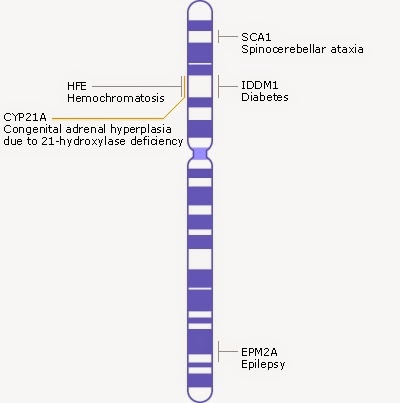
Schematic of chromosome 6, taken from
http://www.ncbi.nlm.nih.gov/books/NBK22266/#A278

THE HFE GENE

Chromosomes are depicted as shown in the image on the right. The blue bands represent clusters of genes. Chromosome six is composed of 170 million base pairs and contains about 2,000 genes. The HFE gene is just one of these genes, and is 8,000 base pairs long. There are 20 different locations along this 8,000 base pair region which will result in hemochromotosis. However, there are two locations in particular where mutations occur quite frequently, and they result in two changes in the HFE protein. These mutations are called C282Y, and H68D. 

ADDITIONAL MUTATIONS
There are at least 52 additional point mutations across the HAMP, HFE2, SLC40A1, and TFR2 genes that can all result in hemochromtosis. 

MEDICAL RELEVANCE
I mentioned in the beginning that I have hemochromotosis. However, this may not be entirely accurate. My situation is that I was screened for HH on the basis of a blood test which showed elevated iron levels. However, the genetic test showed an unusual result. Most people with HH are homozygous in that they have two copies of the defective HFE gene. My results came back as being heterozygous, with one copy of my HFE gene having both the C282Y, and H68D mutation, which my doctor says should not result in any symptoms. However, I do have at least some of the symptoms, and I would like to rule out HH as one of the causing factors. Until I started researching this disease I was unaware there were so many genes and point mutations that could result in its development. Personally, I find it interesting, but I would also like to know that my doctors have considered the possibility that I also carry a defective copy of one of the other HH genes. However, I think I am correct in saying that the probability of me having another defective copy of a mutated gene which relates to HH, but is not the HFE gene are reasonably slim due to something called conjunction fallacy, see here.

CONCLUSION
So, you now understand the basics of hemochromotosis. There will undoubtedly be much more for me to discover about this disease, and as mentioned, I plan to provide additional posts that go into details on the biochemistry of the disease. Each of these defective genes make a unique protein that misbehaves in a unique way which will very exciting to learn more about. I appreciate this is a very technical blog post, so if there were things you did not understand it's because I have not explained them well. If this is the case, feel free to leave a comment below, and I will happily review and re-write to make it better.

USEFUL MATERIAL
Original research paper Hemochromatosis types 1, 2, and 3

Thursday, 12 June 2014

Ubuntu For Biologists

BACKGROUND
This article is designed to expose you to alternatives for Windows and Mac operating systems, which let’s face it either perform poorly, or are prohibitively expensive respectively. This is not designed to solve all of your problems, but rather to make you aware of what Ubuntu is, and why you might be interested in using it. Keep in mind as you read this that I am an entry level user myself.
OKAY, I'M IN - HOW MUCH DOES IT COST?
Ubuntu is a free Linux based operating system that is available for anyone to download and install. It is a viable and frankly sexy alternative to Windows, or Mac operating systems. For relatively basic users like me you should have no problems getting it to perform for you.  
SO - WHY IS IT BETTER THAN WHAT I HAVE ALREADY?
The short answer is, it may not be. If you already own a Mac then I would say, good for you. They are known for being reliable and dependable computers. Since the early 2000’s Mac have built their software on the back of Linux based distributions, so they already have a lot of the benefits I will mention here, apart from the costs of their products. If you are considering getting a Mac then this article might be important for you. If you already own a Windows computer and you are finding it doesn’t really meet your current needs, this article is for you.
LOOK AND FEEL
Ubuntu looks pretty nice out of the box, but a few small teaks make it nicer to look at. But overall, things are in the right place. It looks much more like OS-X than Windows, and behaves more smoothly than Windows. The main task-bars are to the left or on the top, actually much more comfortable to see and use than the typical Windows placement of icons.
Desktop view of ubuntu after some modification to make the taskbars transparent.
Applications are launched via a single click on the icons, and new software is installed via the software center, which is a carefully maintained repository of software known to behave with Linux. It's routinely checked for spyware and viruses by the Linux development community, so the risk of installing something that will compromise your computer is limited.

SPEED AND SECURITY
Ubuntu is fast. There are applications you can use to measure how one computer behaves under different operating systems, but you won’t need to check. Installing Ubuntu will make it seem like you have a new computer. And the performance does not degrade over time. Ubuntu is not just fast to install or fast at opening applications, it is fast to work with because of how you find and store you files, how you launch applications, and how you utilize the desktop. One easy example is that of multiple/virtual desktops. This is a feature of every Linux distribution as standard, and is amazingly still not a feature in Windows unless you find and install additional software (read, time + risk of viruses)
This feature is the single biggest time saving  feature I use on a daily basis. It is arguably better than having four big monitors set up in front of you. As a scientific researcher it allows me to separate my work flow. Research papers and reference manager open on one screen, my current word document open on a second, my plots, images, and data on a third, music and email on a fourth. Skipping between screens is a simple combination of buttons, (Ctrl + Alt + Arrow). It just works well, and I miss it every time I have to use a Windows computer.
As for security, this is not a topic I know much about, but there is a lot of discussion on software forums. The consensus seems to be that every OS is susceptible to attack, and there is no bullet proof system you could use. However, the more people there are who use that OS the more likely it is to be a target. Simply put, why write a virus that will allow you to steal 100 peoples bank details when you could steal 100,000 peoples bank details. However, Ubuntu is not secure just because it is less popular. It is built to restrict access although not in an annoying way. For those who would like to see the debate, check this link, http://askubuntu.com/questions/1069/why-is-ubuntu-more-secure-than-windows-or-mac-os-x.
From my own experience, I am never worried that I will pick up something that will compromise my computer. I have yet to encounter something that has been a problem, and patches are very quick and simple to install. Only sometimes do they require a restart of the computer to take effect. It’s also worth noting that this means there is no need for anti-virus software for Ubuntu, although it does exist. This means you are not scanning your computer every week. Ever try to use your computer while Sophos is doing a scan? You may as well take a coffee break.
WHAT SOFTWARE DO YOU GET WITH UBUNTU?
Ubuntu comes preloaded with some useful applications, and in general you can do a lot more with the “out of the box" installation compared to Windows 7 which still doesn’t come bundled with office software. Everyone’s needs are different, but with Ubuntu you will find most of what you need, and the overwhelming majority of it will be available free of charge. Personally, I needed and wanted the following applications,  
OFFICE BASED APPLICATIONS:
  • Office software
  • Reference Management Software
  • Dropbox
  • Google Drive
  • Image viewer
  • Plotting Software (numerous, but Qtiplot is pretty useful and easy)
HOME APPLICATIONS:
  • DVD player/DVD burner
  • Audio conversion tool
  • An AVI to DVD converter
  • Music player
  • e-book library manager.
OFFICE APPLICATIONS:
For office software, Ubuntu comes preloaded with Libre Office, an open source version of MS Office. This works fairly well, but actually I still use MS office thanks to a little piece of software called PlayOnLinux, which allows you to install Windows and Mac software to your Linux computer. If you can do this I would recommend it, it’s not really worth getting to know Libre Office, almost no-one else uses it, so you will spend your time converting files to MS Office readable formats. 
As for reference management software, Mendeley works perfectly well with Ubuntu, although only with Libre Office so far. This is the biggest problem I have encountered in my migration from Windows to date, but Word 2010 and above have in-built reference managers which can be exploited in the meantime. It’s not perfect, but putting pressure on Mendeley to fix this is a viable option. 
USEFUL APPLICATIONS:
Other handy applications for Windows work well with Ubuntu, including Dropbox, and Google Drive, although currently there is no desktop version of Google Drive, you still have access from your browser , again this is something that could be improved upon.
For viewing and manipulating images there are a number of good options, gThumb and RawTherapee for example are both good for basic fixes such as rotation, artificially colouring the image, sharpening, and cropping. For plotting graphs, Qtiplot is a pretty good application. It looks and behaves similar to the plotting software Prism. It does take some time to get used to, but after about 30 minutes I was able to generate nice looking linear and sigmoid plots altering details like the axis titles, plot colour and plot size. It is also easy to save/copy and paste the resulting plots into word documents.
As for the rest there are numerous music players, but I really like Amarok. It’s smart and easy to use, and allows you to set up podcast streams by simply adding the RSS feed url. Importing music is a simple as drag and drop, and it automatically scans for album art and metadata. For playing DVDs and almost every other format, download VLC player. It just works, there’s not much more to mention. For burning DVDs download an application called K3b. This is an excellent piece of software, simple to use and fast. A nice addition to have is an application called DeVeDe, capable of converting between AVI/mp4 and DVD file formats without fuss. As for audio conversion, an application called Sound Converter will convert a wide selection of audio files to mp3.  
HOW DO I GET MORE?
All Ubuntu software can be obtained immediately by opening simply accessing their software centre, using one click on the toolbar. From here you can search for key terms, for example, DVD player, or mp3 converter, and you will be presented with a list of options. Take your pick and the application will begin to automatically download and install. Once complete the application is automatically added to the launcher. 
The software centre view of ubuntu. Installation of new software is quick and easy.
CONCLUSION
Ubuntu is fast, and powerful in terms of the sheer number of applications that are readily available. It made a big difference to how I used my computer, and definitely increased my productivity once I could tear myself away from downloading every application that looked even remotely interesting. There are dozens of frankly cool little tools, from Brewtarget, an application to help you with your home brew, to Stellarium for those interested in the stars above them.
USEFUL LINKS
Potential users may find the following links helpful. Also, it is worth noting that you can even try Ubuntu without having to install the software, simply transfer your download to a usb key, or burn it to a DVD, and you can run it from the USB/DVD as though it were installed. It's impressively fast.

1. Getting the software Downloading Ubuntu

2. Getting Netflix working with Ubuntu,  Netflix for Ubuntu

3. Installing MS Office on Ubuntu, MS Office for Ubuntu

4. Controlling Ubuntu from your Android phone, Android and Ubuntu